Is AI Pushing Students to Choose Majors for Reasons Other Than Interest?
Something real changed in the last year: computer science enrollment at four-year colleges dropped 8.1% in fall 2025 — the single biggest one-year drop of any major tracked since at least 2020. That's not a rumor or a vibe; it's enrollment data. The obvious story is "AI took the jobs, so students fled the major." The actual data is more complicated, and more useful to understand before you make a decision based on it.
What's actually shifting
High school signals point the same direction as the college numbers, even if they're thinner. Connecticut reports roughly 3,000 fewer students taking computer science courses than in 2022-23. One national survey found the share of middle/high schoolers naming CS or AI as their top academic interest fell from 42.3% in 2025 to 27.9% in 2026. Counselors are fielding a question they didn't used to get: "should I even bother taking computer science?"
But look closer at what's happening inside that number, and it's not simply "students are leaving tech."
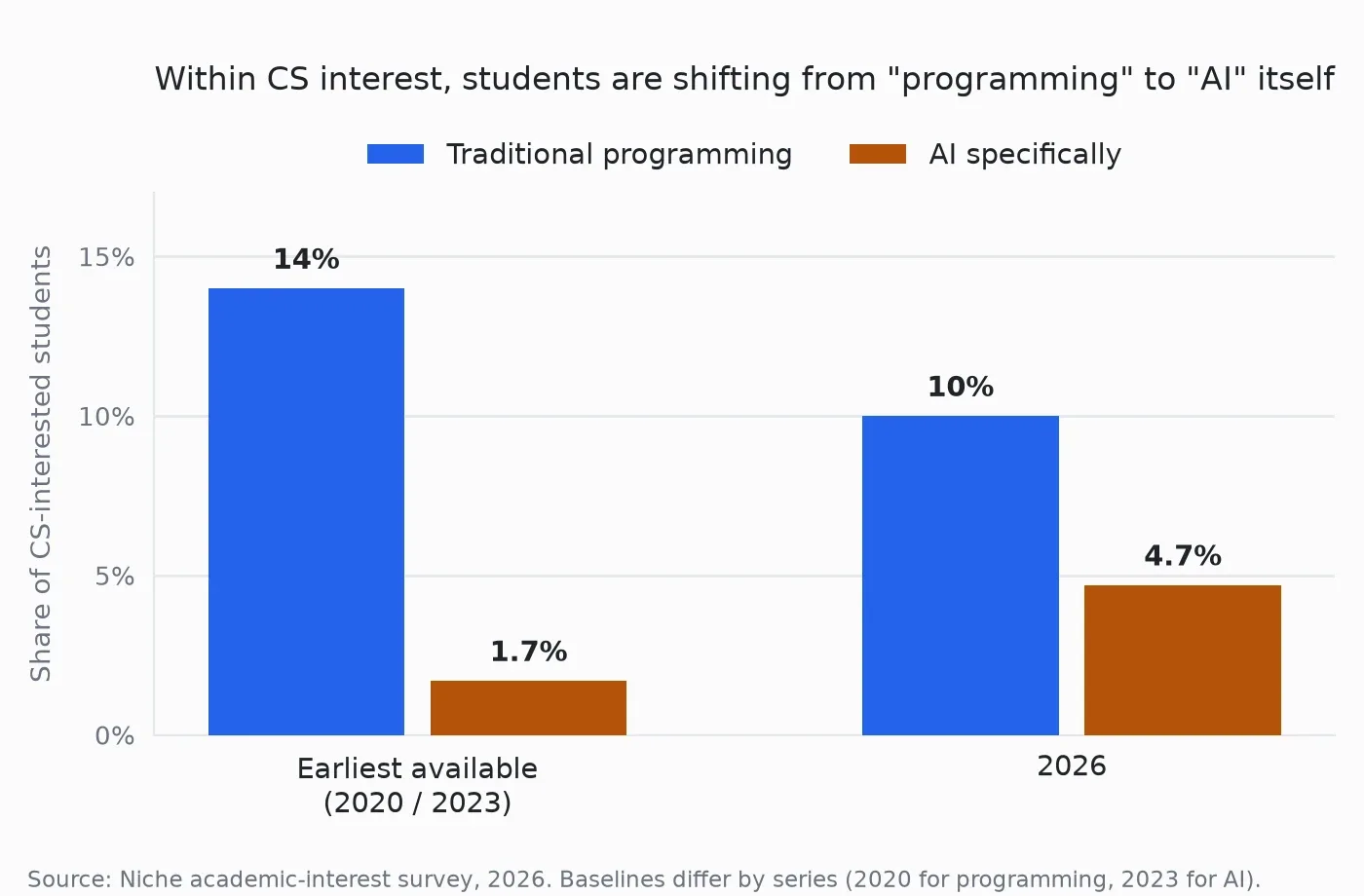
Students aren't fleeing the field — they're retargeting within it, moving away from "write code" and toward "work with AI directly."
The part that complicates the simple story
If the theory is "students are rationally avoiding AI-exposed fields," the data doesn't fully support it. An AI-exposure index built from occupational data scores computer science as one of the most AI-exposed majors there is — more exposed, by this measure, than business, nursing, or education. If exposure were driving the decisions, CS should be near the bottom of student interest, not a field students are still actively discussing switching into (toward its AI-specific track).
And a separate analysis (Niche, across 33 major groups) found no strong relationship between how AI-exposed a field's careers are and whether that field actually gained or lost students. In other words: the major-level enrollment shifts happening right now aren't a clean, rational sorting by AI-exposure score. Something messier is going on — part job-market anxiety, part media narrative, part students reacting to very visible, specific stories (entry-level coding jobs cooling) rather than to a broad, evenly-applied exposure calculation.
So is this making students more pragmatic?
In one real sense, yes: the willingness to switch majors because of job-market fear is itself new and measurable — about 1 in 6 students report changing their major because of AI's effect on the job market, per Gallup/Lumina polling. That's a genuine shift toward ROI-thinking, away from pure interest, happening in real time.
A student who drops CS purely because of a scary headline might accidentally land on the right call — CS really does score as highly exposed. But that's a coincidence, not a decision: the risk is switching into something that sounds safer without checking its own number. Liberal Arts, a common landing spot for students leaving a technical major, scores 59 on the same index — not far behind CS's 65, and well above fields like Business (33) or Nursing (34).
One more thing worth holding onto: this isn't the first time CS enrollment has swung. It dropped after the late-1980s downturn and again after the dot-com crash — and rebounded both times. A one-year 8% drop is real data, but it's not proof of a permanent shift.
What this means if you're choosing a major right now
- Treat "AI-proof" as a myth rather than a category — no index agrees cleanly on which majors qualify, and the field people assume is safest (CS) scores as one of the least safe on at least one serious measure.
- Weigh ROI deliberately, rather than reacting to the loudest headline about a specific field. The pragmatic shift happening across students right now is real — make sure yours is based on the same kind of real data, not just the fear driving everyone else's.
- A major you're genuinely engaged with, that also has a defensible path attached, beats either extreme — pure interest with no plan, or pure ROI-chasing based on a score nobody fully agrees on.
Sources: National Student Clearinghouse enrollment data (via Fortune, AP); Connecticut CS enrollment reporting; Niche academic-interest survey (2026); EDsmart AI-exposure index; Gallup/Lumina student survey on AI-driven major changes.