Choosing a Major You Won't Regret in the AI Era
If you ask people who already finished college whether they'd pick the same major again, a surprising number say no. Two different surveys asked exactly that question, using different methods and different years, and they didn't land on the same ranking — but they landed on the same shape of answer, which is worth paying attention to.
What the surveys found
A ZipRecruiter survey of job-seeking graduates found that 44% regretted their major overall.
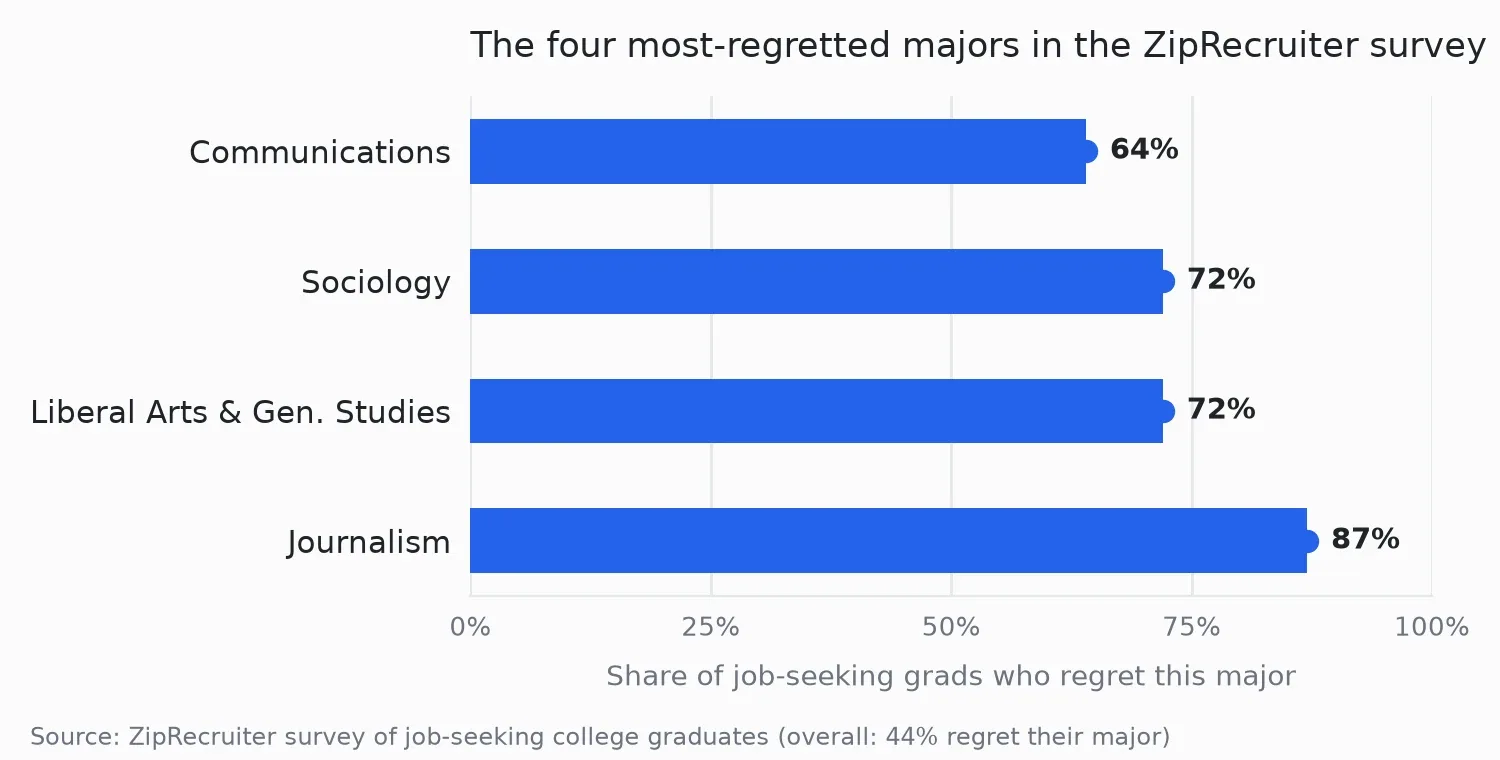
A separate Federal Reserve survey, using broader subject categories, found Humanities & Arts majors were most likely to say they'd choose differently (48%), followed by Social & Behavioral Sciences (44%). Engineering came out as the major people were least likely to regret.
These two studies don't match on specifics — different populations, different years, different category definitions. But they agree on a direction: majors that map onto a specific job — engineering, computer science, nursing — show up with less regret. Majors that don't point to one specific job title show up with more. That's a pattern worth taking seriously, even without a single definitive ranking.
Why people regret a major, according to these surveys
Job prospects and pay dominate the reasons graduates give, though the surveys don't break down every contributing factor — practicality of the field and job satisfaction get mentioned too, separate from salary alone. What they don't capture: things like realizing a field wasn't what you expected once you were in it, or a choice made under outside pressure rather than real interest. Regret, in other words, shows up later, once reality (the job search, the day-to-day work) meets a choice that was made years earlier — but the data here can't tell us exactly which version of "reality" tripped up any one graduate.
The part this data can't tell you — and why it matters now
Here's the catch: these surveys are backward-looking. They're measuring regret caused by yesterday's job market — a market that existed before AI tools became part of how entry-level work gets done. That raises an uncomfortable question: is a new wave of regret already being set up right now, for reasons the surveys above never captured?
A 2026 Federal Reserve/Census study tried to measure something closer to that. Researchers scored majors by how exposed the occupations connected to them are to generative AI, then tracked what actually happened to graduates. The finding: graduates from the most AI-exposed group of majors saw their odds of landing a first job drop by about 5 percentage points after ChatGPT became widely used. That's not a guess about the future — it's a measured outcome that's already happened.
Here's the twist that makes this more complicated than "avoid AI-exposed majors":
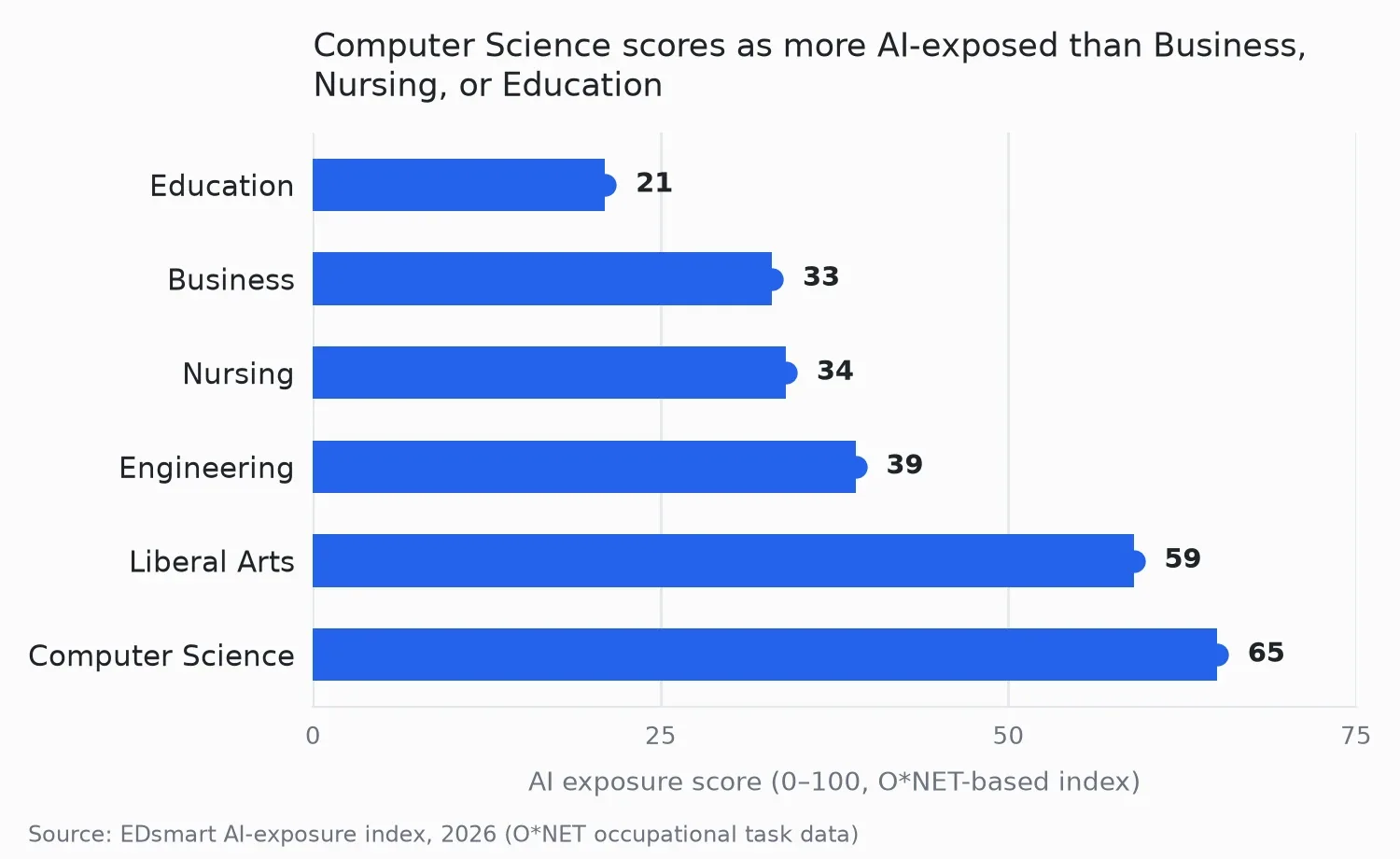
One AI-exposure index (built by EDsmart from occupational data) scores Computer Science as one of the most exposed majors, ahead of business, nursing, and education. That cuts against the usual assumption that CS is the "safe, AI-proof" choice. Different studies score exposure differently, and none of them agree closely enough to hand you a clean ranked list — but the takeaway holds either way: the major that sounds safest from AI and the major that scores safest on paper aren't automatically the same one.
What this actually means for you
Don't treat the regret rankings above as a list of majors to avoid, and don't treat AI-exposure scores as a crystal ball — the methodologies disagree too much for that. What's worth doing instead:
- Ask what the major connects to, concretely — not just "is it interesting" but "where does this lead, and does that destination still look stable."
- Don't assume a tech-adjacent major is automatically the safe bet just because it sounds modern — on at least one serious index, it scores as more exposed to AI disruption than fields people think of as less "techy."
- Treat ROI (what a major realistically leads to) as one input alongside interest, not a replacement for it. The majors with the least regret in these surveys weren't necessarily the ones people found most fascinating — they were the ones with a clear path attached.
Sources: ZipRecruiter major-regret survey (via Newser, UniversityBusiness coverage); Federal Reserve major-regret data (2021); Federal Reserve/Census AI-exposure study (Sept 2026, via FEDS Notes); EDsmart AI-exposure index (2026).